
The artificial intelligence landscape transformed dramatically in January 2026, marking what industry leaders are calling a pivotal inflection point. While 2025 focused on generative AI capabilities and model scaling, 2026 is ushering in a fundamentally different era—one where AI transitions from purely digital tools to autonomous systems operating in the physical world and enterprise environments. This shift represents far more than incremental progress; it signals a wholesale reimagining of how artificial intelligence creates value across industries.
This comprehensive update covers the most significant AI breakthroughs, infrastructure investments, and technological advancements reshaping the field. Whether you’re an AI professional, business leader, or technology enthusiast, understanding these developments is essential to navigating the year ahead.
1. Physical AI Robotics Enter the “ChatGPT Moment”
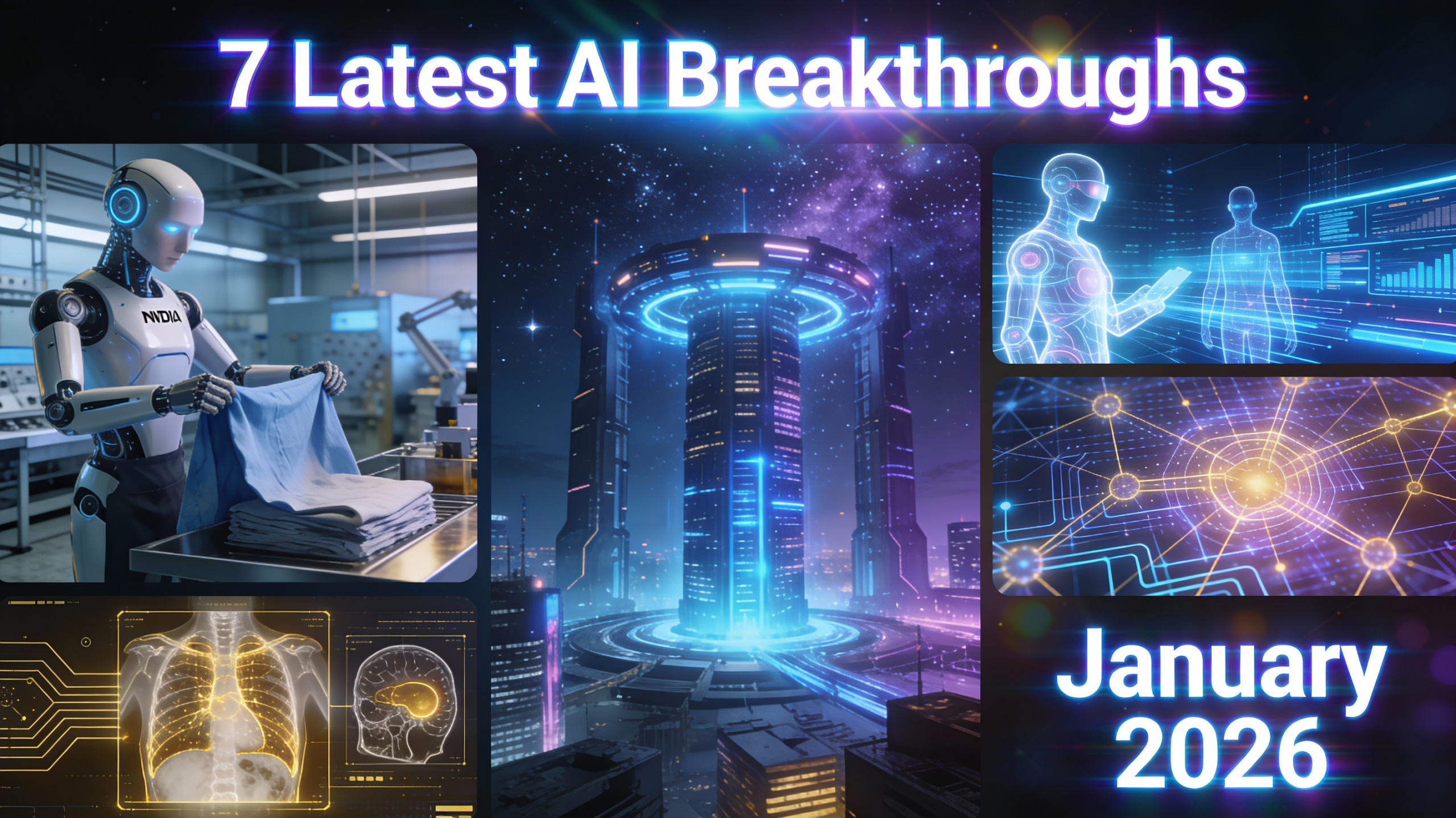
For years, robotics languished in research labs and viral video moments. CES 2026 changed that narrative entirely. NVIDIA CEO Jensen Huang declared that “the ChatGPT moment in robotics has arrived,” signaling the industry’s transition from experimental prototypes to production-ready autonomous systems.
What Changed: Physical AI represents a fundamental convergence of generative AI with robotics, sensors, and actuators. Unlike traditional digital AI that analyzes data, physical AI systems perceive the environment, reason about physical constraints, and execute tasks in real-world spaces. Robots demonstrated at CES performed complex tasks—from laundry folding and breakfast preparation to factory automation—without explicit programming for each action.
Key Innovations:
- NVIDIA unveiled the Vera Rubin platform featuring H300 GPUs engineered for trillion-parameter models.
- Isaac GR00T N1.6, a vision-language-action model, is designed for humanoid robots with full-body control and contextual comprehension.
- Isaac Arena provides an open framework for benchmarking robotic policies in simulation before deployment.
- NVIDIA Cosmos introduces open-source world foundation models trained on videos and robotics data to improve embodied intelligence.
Boston Dynamics’ Atlas robot, now operating under Hyundai Motor Group, is on track for deployment in manufacturing facilities in collaboration with Google DeepMind over the next few years. This transition from exhibition to industrial deployment marks a watershed moment for factories facing acute labor shortages and seeking automation without full infrastructure redesign.
The challenge remains execution on edge devices, since real-world robotics require low-latency decision-making with constrained compute. NVIDIA and its partners are addressing this via simulation-trained models that can transfer robust behaviors into physical environments with minimal cloud connectivity.
2. Autonomous AI Agents Move from Pilots to Production
If physical AI marks robotics’ breakthrough moment, autonomous AI agents represent the enterprise transformation. The distinction is crucial: traditional AI copilots provide recommendations, while agentic AI systems make decisions, execute multi-step tasks, and operate with minimal human oversight.
Market Adoption Accelerating: Gartner forecasts that a large share of enterprise interactions with generative AI will rely on action models and autonomous agents by the late 2020s, yet only a minority of organizations have piloted agentic systems so far. This gap signals both massive opportunity and urgency, as organizations building agent infrastructure now gain a competitive edge measured in years rather than quarters.
Real-World Deployments:
- OpenAI ChatGPT agents (launched in 2025) now autonomously navigate websites, run code, and generate documents for real workflows.
- Salesforce Agentforce helps businesses create AI agents for customer service and lead management, powered by proprietary enterprise data.
- BNY Mellon’s agent initiative has rolled out large-scale agentic capabilities across its workforce to automate research, analysis, and reporting while augmenting employees rather than replacing them.
- U.S. Federal Government programs such as the Genesis-style missions are connecting leading AI firms with national laboratories, with vendors like Oracle integrating battlefield and logistics data streams for real-time analysis.
Critical Infrastructure Gap: Fewer than one in four public-sector agencies have the data architecture needed to support agentic workloads, and similar constraints exist in private enterprises. Agents can only perform as well as the data environments that feed them, which makes investment in data orchestration and governance a direct driver of productivity gains.
2026 Priorities for Enterprise Leaders:
The shift to multi-agent systems demands new governance frameworks, including clear role definitions, monitoring, and fail-safes. Analysts project that most multi-agent systems will consist of specialized agents with narrow roles, which improves accuracy but introduces compounding-error risk; self-verification mechanisms where agents automatically check their own outputs are quickly becoming the production standard.
3. The Stargate Project: A $500 Billion Bet on AI Infrastructure
OpenAI, SoftBank, Oracle, and partners have announced what many compare to a Manhattan Project for the AI era: the Stargate Project. This approximately $500 billion, multi-year initiative to build world-scale AI data centers is poised to reshape computational supply for the entire industry.
Timeline & Deployment:
- Initial investment commitments are on the order of $100 billion in the early construction phases.
- Target capacity is around 10 gigawatts of power, roughly comparable to several large nuclear plants and enough electricity for millions of homes.
- Geographic distribution includes new campuses in Texas, New Mexico, the Midwest, Ohio, and international expansions, coordinated largely through Oracle and SoftBank subsidiaries
Additional plans describe a UAE site designed to serve users within a roughly 2,000-mile radius and UK partnerships to expand sovereign AI compute using tens of thousands of GPUs. Taken together, these sites form a globally distributed fabric of high-density AI infrastructure.
Strategic Implications: This is an unprecedented supply commitment to meet explosive AI compute demand, directly mitigating a major bottleneck for training and deploying frontier models. With Stargate-scale capacity, organizations can train next-generation models and support intensive inference workloads without waiting in years-long queues for compute. The geographic spread also reflects localization strategies that let nations and enterprises run powerful AI systems on domestic or allied infrastructure, which is increasingly important for both regulation and resilience.
Energy considerations sit at the center of the project. Initiatives like OpenAI’s community-focused energy programs aim to offset power costs and prevent upward pressure on local electricity prices as data centers scale. As AI infrastructure grows into multi-gigawatt territory, sustainable energy sourcing and grid integration become existential challenges for the industry.
4. Large Language Models Shift From Scale to Intelligence
The era of “bigger is automatically better” for large language models is ending, and January 2026 has underscored that reliability, reasoning, and efficiency now matter more than raw parameter counts.
Frontier Model Advances:
- DeepSeek V4 (expected in early 2026) showcases coding performance that rivals or exceeds leading Western models while relying on lower-performance chips and a novel Engram learning approach, challenging the idea that only the largest GPU clusters can push the frontier.
- Google Gemini personal intelligence features in the Gemini app allow richer personalization, drawing signals from user content such as photos and emails for more contextual assistance while emphasizing user control.
- Apple’s reimagined Siri, leveraging Google’s Gemini model through Private Cloud Compute, promises on-screen awareness and cross-app integration with privacy-preserving infrastructure.
Three Game-Changing Breakthroughs (per Jensen Huang):
- Model reliability has improved from early, error-prone systems to models that can perform research-like tasks, reason through unfamiliar problems, and produce consistent outcomes.
- Reasoning depth is increasing as models learn to break down complex tasks, recognize mistakes, and shift strategies, often via reinforcement learning approaches similar to those highlighted by OpenAI’s o1 research.
- Physical intelligence enables AI systems to reason about proteins, materials, and physical processes, which is already reshaping drug discovery and industrial design through partnerships between AI companies and pharmaceutical firms.
Post-Training Innovation: The most significant gains now often occur after base model training, where organizations refine models with domain-specific data and tools. This trend democratizes advanced AI, since startups and research labs can adapt open or licensed models for specialized use cases without training from scratch. Examples include IBM’s Granite models and non-profit initiatives like AI2’s Olmo series.
5. Healthcare AI Reaches Clinical Deployment Scale
AI diagnostics have moved from proof-of-concept to standard clinical practice in many health systems, and by 2026 a large majority of hospitals are expected to use AI-driven diagnostics and remote monitoring tools in some capacity.
Clinical Breakthroughs:
- Microsoft’s MAI-DxO diagnostic orchestrator has demonstrated the ability to solve complex medical cases at accuracy levels far above typical physicians, and Microsoft’s existing tools like Copilot and Bing already answer tens of millions of health-related queries daily.
- Cardiac diagnostics from a 10-second EKG at the University of Michigan use AI models to detect coronary microvascular dysfunction, a condition that traditionally required advanced imaging or invasive procedures.
- Pancreatic cancer treatment research now leverages AI-designed molecules to boost chemotherapy effectiveness by targeting resistance mechanisms in tumor cells.
- Dementia detection via EEG-based AI achieves over 97% accuracy in distinguishing healthy individuals from those with Alzheimer’s or frontotemporal dementia, using federated learning to preserve patient privacy.
Personalized Medicine Integration: AI helps enable hyper-personalized medicine by jointly analyzing genetic data, lifestyle factors, and environmental exposures to predict disease risk years before symptoms appear and to recommend targeted interventions. This turns healthcare from a reactive model—treating disease after onset—into a prevention-first approach that focuses on early risk stratification and tailored therapy.
Decentralized Diagnostics: Edge AI is pushing diagnostics closer to patients by equipping portable devices with powerful inference capabilities. Compact EKG devices can support dozens of cardiac measurements, and blood-based tests enhanced by AI are improving early detection of cancers via circulating tumor DNA.
6. Quantum-Classical Hybrid Computing Enters Real-World Testing
After years in research settings, quantum computing is converging with AI in hybrid architectures that are starting real-world trials in 2026. Companies such as AQT Arithmos Quantum Technologies have announced testing programs for hybrid systems running from March through June 2026 to explore practical workloads.
Hybrid Quantum-AI Advantages: Unlike pure quantum computing, which remains limited for many applications, hybrid systems delegate specific optimization or simulation tasks to quantum processors while relying on classical GPUs and CPUs for general machine learning and inference. A useful analogy is that classical AI explores a maze one corridor at a time, while quantum components evaluate many pathways simultaneously through superposition to find better solutions faster.
Practical Applications:
- Quantum optimization can accelerate AI model training and hyperparameter search by significant factors compared with purely classical methods.
- Molecular simulation via quantum-enhanced methods is vital for drug discovery, protein folding analysis, and advanced materials research.
- Cryptography stands at an inflection point, as quantum algorithms threaten classical cryptosystems and drive interest in post-quantum cryptography.
- Finance and logistics use quantum-inspired optimization for portfolio construction, risk management, and supply chain planning.
2026 Adoption Timeline: Enterprise pilots combining quantum and AI are underway in sectors like pharmaceuticals, aerospace, and finance, with broader adoption expected to accelerate between 2026 and 2030 as hardware matures. IBM and AMD, for example, are exploring ways to integrate AMD CPUs, GPUs, and FPGAs with IBM quantum systems so that algorithms can exploit the strengths of both paradigms in a single workflow.
7. The Data Infrastructure Imperative and Security Challenges
A critical insight from January 2026 is that AI agents are only as capable as the data environments that support them. Yet many organizations still operate fragmented data stacks across legacy applications, creating coordination bottlenecks that limit agent performance.
Data as Strategic Infrastructure: Enterprises must now treat data orchestration and integration as mission-critical infrastructure rather than a back-office IT function. Public agencies that have unified operational views—for instance, military logistics environments that consolidate sensor, supply, and intelligence data—can use agents for real-time planning and situational response, while organizations without coherence see agents stall or miscoordinate tasks.
Emerging Security Risks: The rapid expansion of agentic AI also broadens the threat surface. Key vulnerabilities emerging in 2026 include:
- Prompt injection, where attackers craft inputs that cause agents to execute unintended or harmful actions.
- Data poisoning, where adversaries insert malicious data into training or operational pipelines to create systematic errors.
- Algorithmic manipulation, where attackers exploit decision logic to exfiltrate sensitive information or bypass safeguards.
Defensive agentic systems must now match the sophistication of their adversarial counterparts, combining robust input validation, monitoring, and sandboxed execution environments. Organizations that deploy agents without equivalent investment in security controls risk exposing critical workflows and data to novel attack vectors.
Key Takeaways: 2026 as an Inflection Point
The AI developments of January 2026 mark a shift from exploration to execution, where the questions have moved from “Can AI do this?” to “Can we deploy this reliably at scale under real-world constraints?”.
For Business Leaders:
- Autonomous agents are rapidly becoming a default interface for complex workflows, not an optional add-on.
- Physical AI and robotics are poised to reshape labor, safety, and productivity in manufacturing, logistics, and service industries.
- Investing early in data infrastructure, security, and governance is now the decisive factor that separates organizations merely experimenting with AI from those building durable competitive advantage.