

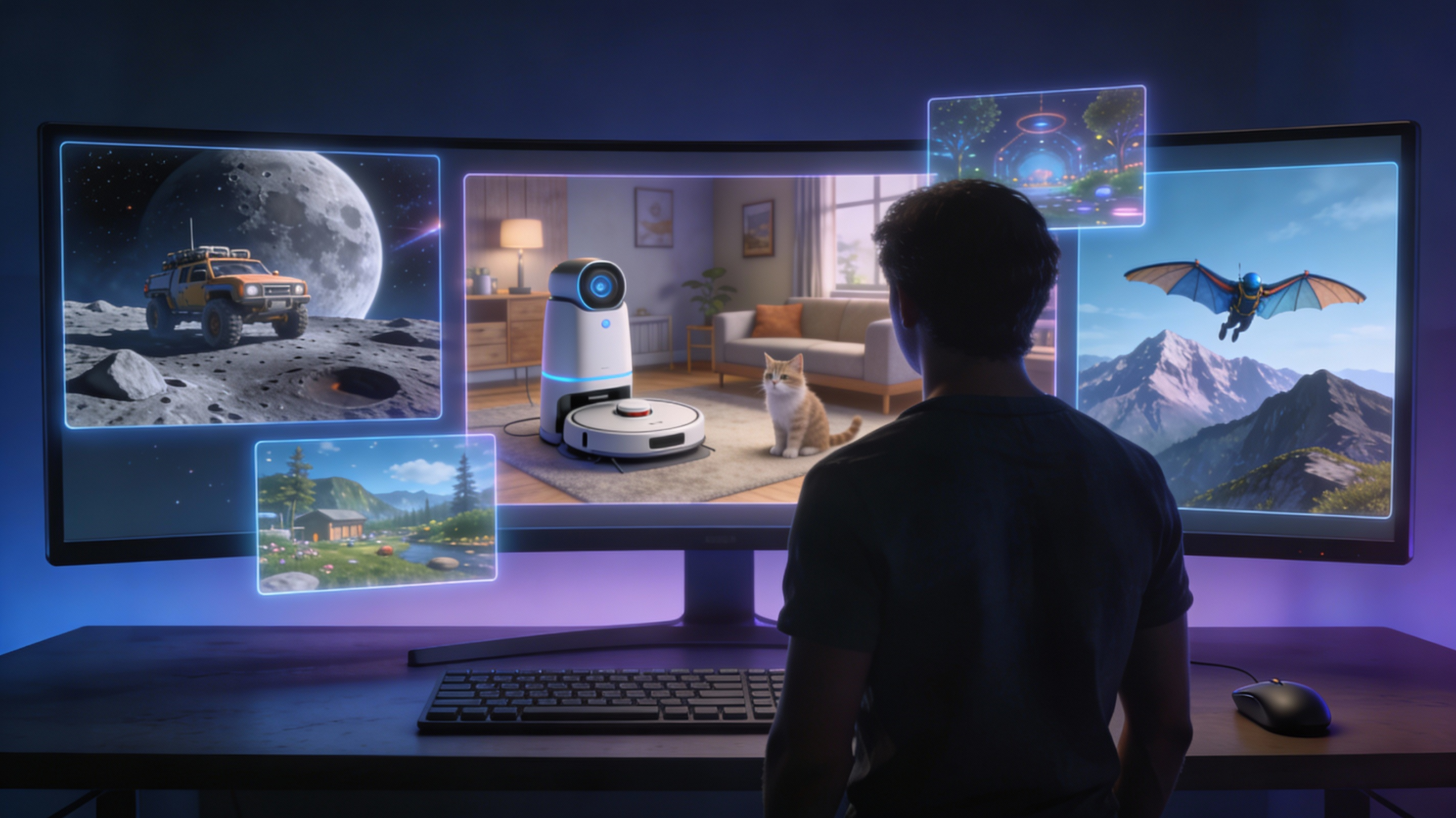
Google has launched Project Genie, a prototype AI experience that turns text or image prompts into short, explorable 3D worlds for Google AI Ultra subscribers in the United States. The Project Genie AI system is built on Google DeepMind’s Genie 3 world model and is positioned as an experiment in real-time, interactive “world models” rather than a full game engine.
Timeline of Project Genie AI
DeepMind first introduced the Genie line of world models prior to Genie 3, which was unveiled in August 2025 as a general-purpose, real-time interactive world model. In that 2025 announcement, DeepMind described Genie 3 as a key stepping stone toward artificial general intelligence by generating diverse, physically consistent environments for agents to explore.
On January 28–29, 2026, Google DeepMind made Project Genie publicly accessible as an experimental Labs experience for AI Ultra subscribers in the US, running Genie 3 behind the scenes. Reports indicate that each Project Genie AI session currently supports around 60 seconds of interactive world exploration per generation, with Google describing this limit as a quality and consistency trade-off.
Key players and technology
Project Genie AI is developed by Google and its AI research arm, Google DeepMind, which leads the Genie 3 world model research. DeepMind researchers have described Genie 3 as the first real-time, interactive general-purpose world model, capable of generating both photo-realistic and imaginary environments.
On the product side, Project Genie is delivered via Google Labs and restricted to AI Ultra subscribers aged 18 or older in the United States, with plans to expand access to additional regions in the future. The wider ecosystem includes related Google AI systems such as Gemini, which contributes to world generation alongside the core Genie 3 model.
How Project Genie AI works
Genie 3 is an auto-regressive world model that generates environments frame by frame, using prior frames and user actions to determine how the next moment should look and behave. This approach allows Project Genie AI to maintain short-term consistency in its virtual worlds, including persistent changes when users move objects or interact with the environment for several minutes
In Project Genie, users can type a prompt or upload an image to generate a short, interactive 3D scene, which they can navigate in real time at roughly video-game-like frame rates. Google currently limits each interactive sequence to about 60 seconds, stating that this time window yields higher-quality and more stable worlds, even though the underlying Genie 3 model can technically run longer.
Reported impacts on gaming and work
Project Genie AI arrives at a time when the game industry is experiencing significant layoffs and rising concern over generative AI’s role in development workflows. A recent Game Developers Conference (GDC) survey found that 52 percent of game industry professionals believe generative AI is having a negative impact on the industry, up from 30 percent the previous year and 18 percent the year before.
Google says Project Genie AI is not a full game engine and cannot create complete game experiences, but it views the tool as useful for speeding up ideation, prototyping, and experimentation with interactive concepts. Some industry respondents, however, have warned that platforms like Genie could eventually displace traditional game development roles by enabling users to prompt and direct their own content.
Reactions and concerns
Many developers in visual and technical art, game design and narrative, and programming roles hold particularly unfavorable views of generative AI tools, with negative sentiment above 60 percent in several of these disciplines. Critics argue that tools such as Project Genie AI risk devaluing creative labor and accelerating job losses in an already fragile sector, even as adoption of AI tools for tasks like research, brainstorming, and prototyping continues to grow.
Supporters, including some AI researchers and platform providers, frame Genie 3 and Project Genie as important advances toward more capable AI systems that can learn from simulations rather than static datasets. They highlight potential benefits in rapid prototyping, new forms of interactive media, and low-barrier experimentation for users who lack technical game development skills.
Broader context and next steps
n Google’s framing, Project Genie AI showcases how world models like Genie 3 could help train future AI agents to navigate complex, evolving environments, which the company views as essential for progress toward artificial general intelligence. The current prototype still has notable limitations, including imperfect visuals, lagging agents, difficulty rendering legible text, limited action sets, and missing features such as promptable in-world events.
Google plans to iterate on Project Genie, potentially extending access beyond US AI Ultra subscribers and adding capabilities that were demonstrated in research but are not yet present in the consumer-facing prototype. In parallel, industry bodies such as GDC will likely continue tracking how tools like Project Genie AI affect employment, workflows, and sentiment in game development and adjacent creative fields.