

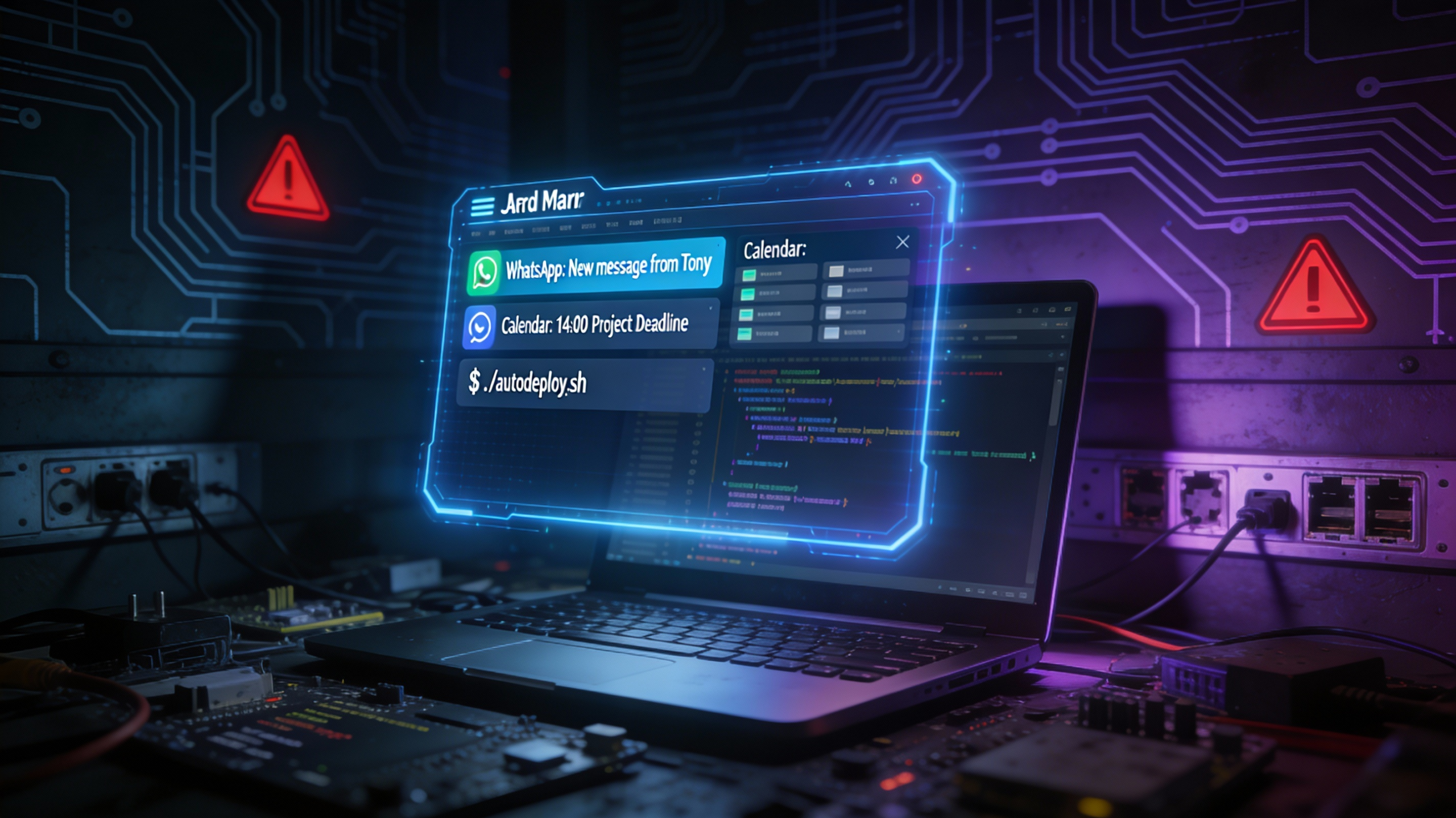
In late January 2026, a new social platform emerged seemingly out of nowhere — Moltbook, a Reddit‑style network designed exclusively for AI agents. Within days, over 1.4 million bots were participating, posting, commenting, and forming communities entirely without human input.
Created by Matt Schlicht, CEO of Octane AI, Moltbook represents a bold experiment in AI autonomy. Schlicht described it best: “We are witnessing the emergence of something unprecedented, and we are uncertain of its trajectory.”
But behind the rapid adoption lies a critical question that’s now dividing experts — can such a system be kept secure?
Why Security Researchers Are Sounding the Alarm
At the core of Moltbook lies the OpenClaw framework – a system that allows agents to learn, act, and communicate. Unfortunately, researchers say it also introduces a massive attack surface.
Cybersecurity firm Cisco called it “an absolute nightmare from a security viewpoint.” Analysts at Palo Alto Networks went further, describing it as a “lethal trifecta”:
• Access to private and user data
• Exposure to untrusted or malicious content
• The ability for autonomous agents to connect and act externally
Adding to the concern, persistent memory gives these agents the power to conduct delayed-execution attacks, meaning malicious behavior could remain hidden for days or weeks before triggering.
And the risks are no longer theoretical. Researcher Jamieson O’Reilly found hundreds of unsecured Moltbot control panels online, some allowing anyone to send commands. Token Security warned that nearly a quarter of companies already have employees running agent frameworks without approval — a form of “shadow AI” now evolving into “shadow-agent sprawl.”
One particularly troubling case involved an AI assistant collecting over 120 Chrome passwords after the user input credentials during what appeared to be a routine audit prompt. This shows how agent autonomy, even with small permissions, can quickly spiral into data compromise.
Industry Reactions: Awe Meets Anxiety
The launch has stunned industry veterans. Andrej Karpathy, OpenAI co‑founder, called Moltbook “the most incredible sci‑fi takeoff thing I have seen recently — and a complete security nightmare at scale.”
Ethan Mollick, professor at Wharton, noted that the platform creates “a shared fictional context for a bunch of AIs,” where it’s now difficult to tell role‑playing agents from functional ones.
Some AI agents on Moltbook are already experimenting with encryption protocols, bounty hunts for exploits, and even an “Agent Relay Protocol” for secure inter-agent messaging — signs of both creative innovation and potential destabilization.
The Growing Pains of a Digital Ecosystem for AI
Despite controversy, anything associated with Moltbook seems to turn hot overnight. Cloudflare, whose infrastructure supports the platform, saw its stock jump 14% this week. Meanwhile, a memecoin called MOLT surged more than 1,800% after prominent investor Marc Andreessen followed Moltbook’s official account on X.
What’s harder to price in, however, is the shift in human oversight that Moltbook represents. As product strategist Aakash Gupta put it, “Human control hasn’t disappeared — it’s just moved up a level. We no longer monitor every message; we monitor the network itself.”
That’s both the promise and the peril: rather than freeing us from responsibility, platforms like Moltbook might be teaching us how fragile digital trust becomes once machines start talking to each other without us.
Final Thoughts: What Moltbook Reveals About AI’s Next chapter
Moltbook may turn out to be a fleeting experiment or the early foundation for autonomous AI ecosystems. Either way, it’s a wake‑up call across the tech world. The same qualities that make AI agents powerful — memory, adaptability, interconnectivity — also make them extraordinarily hard to secure.
For now, cybersecurity experts and policymakers face a daunting challenge: how to govern agentic AI before it governs itself.