
Tesla has officially confirmed a $2 billion investment in xAI, Elon Musk’s artificial intelligence startup, in a move that underscores the company’s dramatic strategic pivot away from traditional electric vehicle manufacturing toward AI-powered robotics and autonomous driving systems. The investment, disclosed through a formal shareholder letter on January 28, 2026, represents one of the most concrete signals yet that Tesla is betting its future on artificial intelligence at scale.
The news arrived as Tesla reported stronger-than-expected Q4 profitability, yet the company simultaneously announced a $20 billion capex plan—more than double its prior year’s spending—focused on retooling factories for Optimus humanoid robot production and advanced AI systems rather than traditional automotive manufacturing. The xAI investment is expected to close in Q1 2026, subject to regulatory approval.
Timeline: From Shareholder Skepticism to Confirmed Investment
The path to this investment reveals evolving investor confidence in Tesla’s AI strategy:
- November 2025: Shareholders vote on a non-binding measure encouraging xAI investment; the measure fails to reach required thresholds due to abstentions, though a majority voted in favor
- January 15, 2026: xAI completes a $20 billion Series E funding round, bringing its total valuation to approximately $50 billion
- January 28, 2026: Tesla publicly confirms it has already invested $2 billion as part of xAI’s Series E round and announces a framework agreement with xAI for strategic AI collaboration
- Q1 2026: Expected close of the Tesla-xAI transaction, subject to customary regulatory conditions
Key Players and Investors
The $2 billion positions Tesla as one of the largest investors in xAI’s latest funding round. Other notable investors in xAI include venture firm Valor Equity Partners, Fidelity, Qatar Investment Authority, and strategic investors Nvidia and Cisco. xAI’s previous capital raises and strategic partnerships have positioned it as a serious competitor to OpenAI in the race to develop large language models and AI systems for real-world applications.
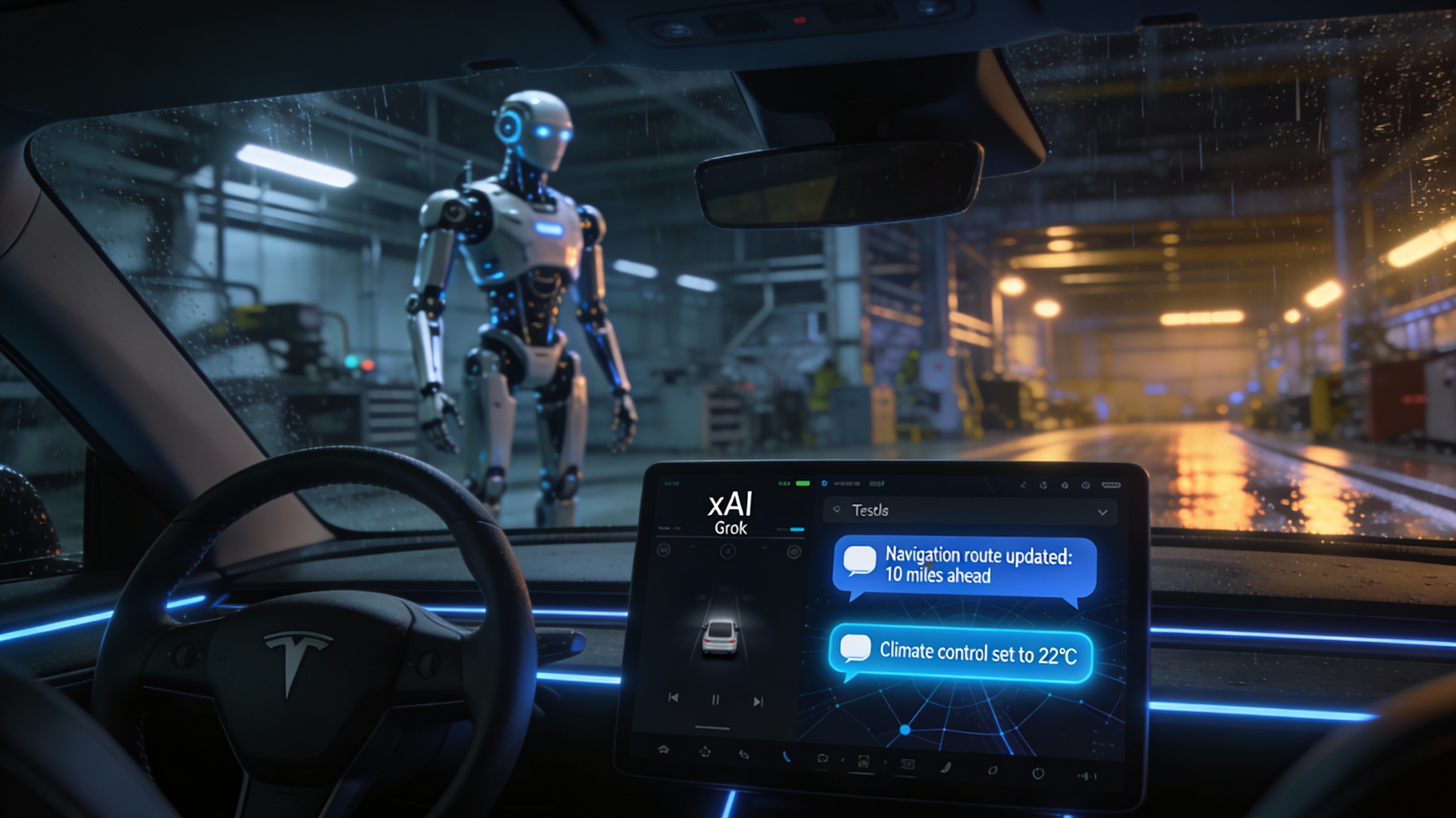
Tesla CEO Elon Musk founded xAI in 2023 and has positioned it as a research-focused competitor to OpenAI’s ChatGPT. The xAI team has already developed Grok, a conversational AI chatbot that Tesla began integrating into its vehicle fleet starting in late 2025.
What the Investment Signals: AI Over Autos
In its shareholder letter, Tesla made explicit why the xAI investment matters to its future: “Together, the investment and the related framework agreement are intended to enhance Tesla’s ability to develop and deploy AI products and services into the physical world at scale.” This language reflects a fundamental corporate reorientation.
Several concrete developments underscore this shift:
- Optimus Production: Tesla plans to retool its Fremont factory to produce up to 1 million Optimus humanoid robots annually by 2027, a project that requires sophisticated AI systems that xAI’s research is designed to support
- Autonomous Vehicles: Tesla currently operates approximately 500 robotaxis in Austin and San Francisco, conducting randomly selected paid rides without safety drivers. The company reported 1.2 million Full Self-Driving (FSD) subscriptions as of Q4 2025, representing the commercial foundation for autonomous services
- Fleet Intelligence: Grok, xAI’s chatbot, is already live in select Tesla vehicles, providing customers with in-vehicle AI assistance powered by xAI’s language models
- Power Infrastructure: Tesla supplies Megapack energy storage systems to power xAI’s data centers—a symbiotic relationship that deepens the strategic partnership
During Tesla’s earnings call, CFO Vaibhav Taneja stated: “If you examine Tesla vehicles, we are currently utilizing Grok in them.” This confirms that xAI’s technology is already operationalized within Tesla’s ecosystem.
Broader Industry Context: The AI Infrastructure Race
Tesla’s $2 billion commitment arrives amid an unprecedented capital surge in AI. Days earlier, Reuters reported that Nvidia, Microsoft, and Amazon are in talks to invest up to $60 billion in OpenAI as part of a potential $100 billion funding round. Concurrently, memory chip supplier SK Hynix posted record quarterly profit of $13.5 billion, more than doubling year-over-year, driven entirely by insatiable demand for high-bandwidth memory (HBM) used in AI data centers.
This convergence of events—corporate AI investments, record hardware sales, and infrastructure buildouts—reflects what Blackstone analysts have termed the most significant economic growth driver of the next decade: artificial intelligence commercialization. Tesla’s xAI investment must be understood within this structural shift: the company is not simply speculating on a technology, but positioning itself to own both the physical AI products (Optimus robots) and the AI systems (xAI models) that will power them.
Musk’s Vision: “Many” Investors Requested This
During the earnings call, Musk downplayed the surprise element of the announcement: “We’re just fulfilling what shareholders requested, for the most part. Many investors have sought the investment in xAI.” This suggests institutional pressure was building for Tesla to formalize its xAI relationship, which it had previously only explored in informal collaboration.
The earlier shareholder vote failure in November 2025 may have motivated Tesla’s board to structure the investment as a direct capital commitment through the xAI Series E round rather than as a new Tesla shareholder resolution. This approach sidesteps the need for another shareholder vote while achieving the same strategic objective.
What Happens Next: Q1 Regulatory Review and AI Roadmap Clarity
The investment will enter a regulatory review period in Q1 2026 before final close. More importantly, investors will watch for quarterly updates on:
- Optimus production ramp: How many units Tesla ships in 2026 and the adoption rate among commercial customers
- Grok integration expansion: Whether Grok becomes standard across Tesla’s global fleet or remains limited to specific markets
- Robocab deployment: Tesla’s plan to launch a robotaxi service with commercial Cybercab vehicles alongside Optimus robots
- Capital allocation clarity: How the $20 billion capex plan breaks down between Optimus, Cybercab, and traditional EV platforms (Model S and X are being discontinued)
Why This Matters to the AI Industry
Tesla’s $2 billion xAI investment is significant because it represents a major corporation betting capital on the thesis that physical AI (robots, autonomous vehicles) and digital AI (large language models) must be jointly developed to create defensible competitive advantages. Unlike previous AI investments by tech companies focused purely on cloud-based AI services, Tesla’s model integrates AI directly into hardware products sold to consumers and businesses.
If successful, this approach could establish a new template for AI commercialization: vertically integrated AI development (model creation, training, deployment) paired with proprietary hardware platforms. If it struggles, Tesla could face significant writedowns and strategic dilution.
Key Takeaway
Tesla’s confirmation of its $2 billion xAI investment marks the company’s most formal commitment yet to its AI-first future. The deal provides concrete evidence that major corporations are willing to commit significant capital to the emerging robotics and autonomous systems market. For investors and AI watchers, it signals that the conversation around AI value has moved beyond chatbots and cloud APIs toward the integration of AI into physical systems that interact with the real world—and that deep-pocketed corporations are betting billions that this shift will drive the next decade of economic growth.