
Table of Contents
The Decision That Keeps Founders Up at Night
You’ve validated your AI product idea. You have users. Now comes the hardest question: Should you build a custom AI solution from scratch, or buy an existing platform?
This isn’t just a technical decision—it’s a strategic lever that determines your speed to market, long-term costs, competitive advantage, and whether you’ll spend the next 18 months shipping features or managing vendor relationships.
Here’s what we discovered researching this dilemma across 50+ founders, industry frameworks, and real discussions from builders in the trenches.
The Truth Nobody Tells You: The 60-70% Problem
Off-the-shelf AI solutions are convenient. They’re marketed as plug-and-play. But here’s what founders actually experience:
Off-the-shelf tools solve approximately 60-70% of your unique business needs.
One developer captured it perfectly: “Whenever I explore commercial platforms, it often seems like I’m only getting 50-70% of what I truly require.”
This means that buying a SaaS solution doesn’t mean you’re done. You’ll likely spend weeks building integrations, customizing workflows, and retrofitting the tool to match how your business actually operates. That’s not buying anymore—that’s building on top of someone else’s foundation while paying monthly subscription fees.
The result? You get slower customization, less control over your roadmap, and you’re paying convenience premiums that can scale to 264x markup on commodity AI capabilities.
The Three Core Factors: Cost, Speed, Control
Every build vs. buy decision comes down to three dimensions:
1. Cost: The True Picture Beyond Sticker Price
Most founders look at annual subscription fees and assume buying is cheaper. This is where analysis breaks down.
Off-the-shelf total cost of ownership (3-5 years):
- Annual subscriptions: $5,000–$40,000/year
- Hidden integrations and data cleanup: $10,000–$50,000
- Training and change management: $5,000–$20,000
- Scaling costs: API usage fees grow exponentially (pay-per-prediction)
- Vendor lock-in switching costs: $20,000–$100,000+ to migrate later
Total? Often $75,000–$250,000 over five years.
Custom AI development (3-5 years):
- Initial investment: $50,000–$300,000 (depends on complexity)
- Annual maintenance: $5,000–$20,000
- Long-term benefit: Your operational costs decrease as your AI improves. You own the code. You control optimization.
The crossover point? If you’re building something complex or high-volume, custom usually wins by year 3.
2. Speed: When Time Is Your Rarest Resource
This is where off-the-shelf solutions shine.
Off-the-shelf: 2-4 weeks to first value (API integration + basic setup)
Custom build: 3-6 months to meaningful deployment
Hybrid: 4-8 weeks to launch with customization
If your market window is closing—you need to launch an MVP in 30 days, or a competitor just raised funding and is moving fast—buying wins. Speed matters more than perfect customization.
But here’s the trap: founders often overestimate time pressure. A feature that “must launch in 4 weeks” often has more flexibility than initial pressure suggests. The real question isn’t “Can we afford to wait?” but “Is the market actually moving that fast?”
3. Control: Whose Roadmap Are You Following?
This is where the philosophy emerges.
When you buy: You’re dependent on the vendor’s product roadmap. If they don’t prioritize your use case, you’re stuck waiting or building workarounds.
When you build: You own your entire technology stack. Every feature, every optimization, every pivot happens at your speed and on your terms.
For founders in regulated industries (healthcare, finance, legal) or those building defensible products, control often outweighs the other factors.
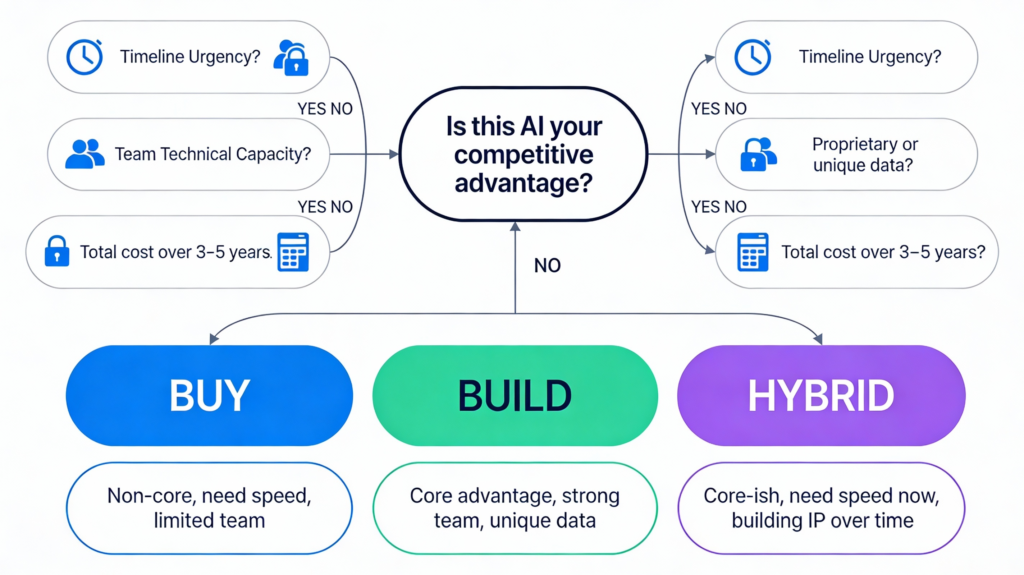
The Decision Matrix: Where Does Your Product Land?
Here’s the framework that separates smart decisions from expensive mistakes.
Score your situation on each dimension (1=Buy, 5=Build):
| Factor | What To Consider | Score |
|---|---|---|
| Is this capability your core competitive advantage? | “No” = Buy, “Yes” = Build | ___ |
| How urgent is speed to market? | “Urgent (4 weeks)” = Buy, “Patient (6+ months)” = Build | ___ |
| Do you have strong technical talent? | “No AI expertise” = Buy, “Strong team” = Build | ___ |
| How unique is your data? | “Generic/standardized” = Buy, “Proprietary/unique” = Build | ___ |
| Are there proven solutions in your space? | “5+ mature vendors” = Buy, “Nothing close exists” = Build | ___ |
| Is compliance/regulation a factor? | “Standard requirements” = Buy, “Industry-specific needs” = Build | ___ |
Scoring: 6-15 points = Buy. 16-25 points = Hybrid. 26-30 points = Build.
When to Buy: Three Clear Scenarios
Scenario 1: It’s Not Your Differentiator
Your competitive edge is your data, your team, your go-to-market strategy—not your authentication system, payment processor, or analytics dashboard.
Buy these: Authentication (Auth0, Firebase), Payments (Stripe), Analytics (Segment), Vector databases (Pinecone).
Buying commodity infrastructure is smart. You’re preserving engineering bandwidth for what actually makes you different.
Real example: A productivity SaaS founder uses GPT-4o mini for text classification, Claude 3.5 for complex reasoning, and managed Postgres for vector storage. She’s buying the AI models and infrastructure. She’s building the business logic and UX that customers actually pay for.
Scenario 2: You Don’t Have Time
Market windows close. Sometimes the constraint is calendar time, not technical time.
If you have 4 weeks to launch an MVP with AI features, buying is strategic. You can iterate toward custom solutions later if needed.
Real example: A solo builder launched an AI tool in 4 weekends using off-the-shelf LLM APIs (OpenAI). He accepted rate limits and API costs to hit his deadline. After proving product-market fit, he could evaluate optimizing the stack.
Scenario 3: Your Team Doesn’t Have AI Expertise
Building AI requires specialized talent: ML engineers, data scientists, or at least developers experienced with prompt engineering and model fine-tuning.
If you can’t hire (or afford to hire) this expertise, buying reduces risk and maintenance burden. You get expert-built solutions without needing to develop expertise in-house.
This is legitimate. Not every founder should be building ML infrastructure.
When to Build: The Competitive Moats
Scenario 1: AI Is Your Product
If your competitive edge depends on algorithmic performance, proprietary workflows, or personalization depth, custom builds protect your IP and prevent commoditization.
Examples:
- Recommendation engines that beat generic models
- Specialized fraud detection for fintech
- Domain-specific legal research tools
- Predictive maintenance systems for manufacturing
These are products where the AI itself is defensible. Building is necessary.
Scenario 2: You Have Proprietary Data
Off-the-shelf models train on generic datasets. Your data—10 years of customer history, proprietary domain knowledge, unique operational patterns—is your moat.
Fine-tuning on proprietary data is where custom builds create competitive advantages that cannot be replicated.
Example: A logistics company with 15 years of route optimization data. A generic routing algorithm improves efficiency by 5%. Their custom model, fine-tuned on proprietary data, improves by 22%. That’s a defensible advantage.
Scenario 3: Regulation Demands It
Healthcare, finance, legal, and manufacturing often have compliance requirements that generic SaaS platforms can’t fully address.
Building gives you control over how data flows, where it’s stored, audit trails, and regulatory documentation. This control is sometimes necessary for certification.
Scenario 4: Long-Term Cost Efficiency
If your AI usage is high—thousands of API calls daily, millions of predictions monthly—custom solutions reduce per-unit costs over time.
This “token arbitrage” benefit: You route simple queries ($0.001 cost) to small, fast models and reserve expensive models for complex reasoning. SaaS platforms don’t usually offer this flexibility.
Break-even analysis: If you’ll use 10+ million API calls annually, custom usually wins financially by year 2-3.
Scenario 5: You Want to Own Your Future
Vendor lock-in is real. Once you’ve integrated a SaaS platform deeply into your operations, migrating costs $20K-$100K+ and takes months.
Building preserves your optionality. You can change underlying models, integrate new data sources, and pivot your strategy without asking permission from a vendor.
This matters if you’re building a company for the long term.
The Hybrid Model: What Winning Teams Actually Do
Here’s what we found when we looked at the most successful AI companies: they use a hybrid approach.
They buy:
- LLM APIs (OpenAI GPT-4, Claude, Llama)
- Cloud infrastructure and vector databases (Postgres with pgvector, Pinecone)
- Authentication and payments
- Monitoring and analytics
- DevOps tooling
They build:
- Domain-specific data pipelines
- Custom fine-tuned models (if competitive advantage exists)
- Business logic and workflow orchestration
- User experience and product design
- Proprietary algorithms and heuristics
Why? This approach gets you to market in weeks instead of months while preserving your intellectual property and competitive moat.
You’re not reinventing authentication or payment processing—both solved problems. You’re building what makes your product unique.
Five Common Mistakes That Cost Founders Thousands
Mistake 1: Buying Too Much
You purchase an all-in-one platform that promises to handle everything. Six months later, you’re writing custom code to work around its limitations, paying monthly fees for features you don’t use, and regretting the lock-in.
Fix: Audit ruthlessly. Which capabilities are truly commodity vs. strategically important?
Mistake 2: Building Without Scope
You decide to build custom. Scope creep sets in. Your “simple AI classifier” becomes a full ML pipeline with retraining, monitoring, A/B testing, and infrastructure management. You’ve underestimated complexity by 10x.
Fix: Define scope ruthlessly. Use the first 2-4 weeks for feasibility validation. Get honest about resource constraints.
Mistake 3: Ignoring Hidden Costs
You look at SaaS pricing and think it’s cheaper. You don’t account for integrations ($30K+), training ($10K+), scaling costs, or switching expenses.
Fix: Calculate 3-5 year total cost of ownership for all scenarios. Include everything: integrations, maintenance, support, scaling, training, switching costs.
Mistake 4: Misaligned Data
Your off-the-shelf tool expects clean, standardized data. Your actual data is messy, unstructured, and poorly documented. You spend months on data cleanup instead of shipping features.
Fix: Audit your data readiness before committing. Structure, cleanliness, and documentation matter more than you think.
Mistake 5: Underestimating Change Management
You build or buy a tool. Your team doesn’t adopt it. The solution fails not because of technical limitations but because people don’t understand it, trust it, or see why they should change their workflow.
Fix: Involve end-users in requirements gathering. Design for ease-of-use from day one. Plan for adoption the way you plan for engineering.
The Step-by-Step Decision Process
Don’t decide in a meeting. Follow this structured process over 3-4 weeks.
Week 1: Define Strategic Importance
Write down honestly: “Is this AI capability a source of competitive advantage, or is it just a necessary feature?”
If it’s a competitive advantage → Build is optimal If it’s a commodity feature → Buy is optimal If you’re unsure → Continue to Week 2
Week 2: Time-to-Market Reality Check
How much time do you actually have? Not how much you wish you had—what’s the real deadline?
- Urgent (4-8 weeks) → Buy or hybrid
- Moderate (3-6 months) → Hybrid is ideal
- Patient (6+ months) → Build is feasible
Week 3: Team Capacity Assessment
Do you have (or can you hire) the technical expertise? Be honest. Building AI requires specialized skills.
- No AI expertise → Buy reduces risk
- Some expertise, strong engineers → Hybrid works
- Strong AI team → Build becomes viable
Week 4: Total Cost of Ownership Analysis
Compare 3-year costs across scenarios:
- Scenario A (Buy): $15K/year SaaS + $30K integrations = $75K total
- Scenario B (Build): $100K upfront + $5K/year = $115K total
- Scenario C (Hybrid): $40K build + $8K/year SaaS = $64K total
Which scenario makes financial sense?
Week 5: Scenario Planning
Project 12-36 months ahead:
- Will usage outgrow the tool’s limits?
- Could customer needs diverge from what you bought?
- Will costs surprise you?
Make your decision with this context in mind.
Real Founder Questions: The Ones You Should Ask
Before you commit to build or buy, ask yourself these questions. They matter more than frameworks:
- “If this exact capability already existed at another company, would I be interested in using it?” If yes → probably buy. If no → probably build because it’s core to your advantage.
- “What’s my real constraint: money, time, or talent?” Your constraint determines everything. Money-constrained? Buy and iterate. Time-constrained? Buy for speed. Talent-constrained? Buy to reduce risk.
- “Could a competitor easily replicate this?” If yes, it’s not defensible—build efficiency, not uniqueness. If no, it’s defensible—build it.
- “Will I regret being locked into this vendor’s decisions in 3 years?” If the answer is yes, build. If it’s a commodity (auth, payments), vendor lock-in doesn’t matter.
- “Can I afford to be wrong about this decision?” If you pick wrong on a core component, what’s the cost of switching? High cost? Be conservative and buy proven solutions. Low cost? You can experiment.
- “What would a founder I respect do?” Not for blind copying, but to calibrate your thinking. Who do you admire? What are they doing?
- “Is this decision reversible?” Switching off SaaS platforms is expensive. Building from scratch requires rewriting. Neither is easily reversible. Make sure you’ve thought through the implications.
- “What changes in my market over the next 18 months?” AI is moving fast. Will the tools you buy today still be relevant? Will the skills you hire for building stay relevant? Build flexibility into your decision.
The Emerging Opportunity: The Hybrid Model Is Winning
Here’s what’s really happening in 2026:
The “Wrapper Economy” is collapsing. Companies that just wrap commodity AI in a UI are getting outcompeted. SaaS vendors are 264x more expensive than the underlying models they’re built on. That economic model is cracking.
The hybrid model is winning. Smart founders are using commodity infrastructure (LLM APIs, hosted vector databases, cloud compute) while building proprietary differentiation on top. They get:
- Faster time to market (using proven APIs)
- Lower infrastructure costs (pay-as-you-go)
- Maximum flexibility (can swap components)
- Defensible IP (own the orchestration layer)
- No vendor lock-in (switching APIs is easier than switching platforms)
This is why you see productive companies moving toward this model: buy the best-of-breed components, build the integration layer.
One More Thing: The Three Scenarios in Practice
Let’s see how three different founders approached this decision:
Founder A: E-commerce Startup (Product Is Data-Driven Recommendations)
Decision: Build custom
Why: Their competitive advantage was personalization depth. Generic recommendation engines were insufficient. They invested $150K in building a custom recommendation system fine-tuned on customer data.
Result: 18% higher average order value than competitors using generic solutions. Defensible. Worth it.
Founder B: Consulting Firm (Adding AI to Existing Services)
Decision: Buy + minimal customization
Why: Speed mattered. They needed to launch AI-enabled research tools in 6 weeks. Consultant experts were already on board, so custom building would distract from service delivery.
Result: Launched on time. Consulting efficiency improved 25%. No need to build—buying solved the problem.
Founder C: Productivity Tool (Building AI-Powered Features)
Decision: Hybrid
Why: Core product logic was proprietary (workflow engine, data structures, UX). AI features (summarization, generation) were strategic but didn’t require custom models.
Result: They use OpenAI APIs for LLM capabilities, built custom orchestration layer, own data pipelines. Best of both worlds: shipped fast, maintained control.
The Real Answer
There is no universal “right answer” to build vs. buy.
There’s only the right answer for your situation, your constraints, your competitive positioning, and your timeline.
The founders making smart decisions are the ones who:
- Clearly define what’s commodity and what’s defensible
- Calculate real costs over 3-5 years
- Honestly assess their team capacity
- Stay flexible and revisit the decision
And most importantly, they’re not dogmatic. They’re using hybrid models, buying where it makes sense, and building where it matters.
Your job isn’t to choose between build and buy. It’s to choose wisely based on your specific reality.
What would you do in your situation? Drop a comment— We are reading every single one.
sources:
- Selleo’s “AI Product Strategy: Build vs Buy Software – A Founder’s Decision Framework”
- Forethought.ai’s “Build vs. Buy AI: How to Choose for Your CX Team”
- Brainpool.ai’s “Build vs. Buy: Why Off-the-Shelf AI Solutions Aren’t Always the Best Fit”
- Explore: r/SaaS discussions on “Buy vs Build: AI Tools Flip the Script”
- Explore: Real founder discussions on r/AI_Agents about custom vs off-the-shelf